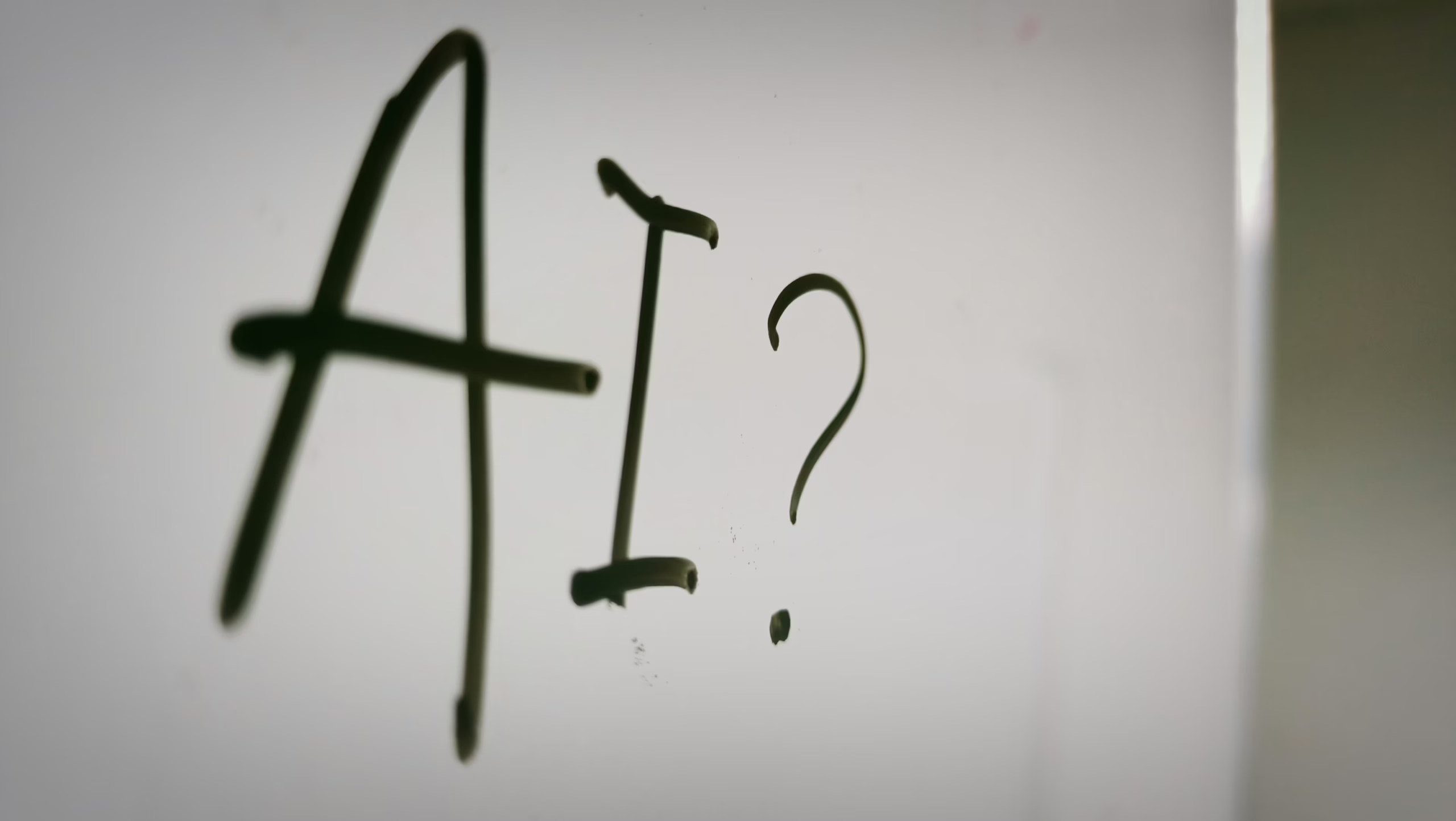
Artificial Intelligence has a branding problem.
Depending on who you ask, AI is either:
- a magical oracle that will solve climate change, write perfect novels, and fold your laundry, or
- an evil robot army sharpening its metal teeth while plotting the downfall of humanity.
Neither is true. And yet… these myths persist. Loudly. Passionately. Often on social media, in headlines, and at family dinners where someone just read half an article and is now very confident.
So let’s fix that.
This article is a deep, myth-busting tour through the top 10 misconceptions about AI — where they came from, why they’re believable, and what the actual facts say. No hype. No doomscrolling. Just reality, explained clearly, with a little humor to keep us sane.
If you read this all the way through, you’ll walk away with:
- a clearer understanding of what AI actually is (and isn’t)
- better intuition for where AI is headed
- ammo for your next “AI is going to destroy everything” conversation
Let’s start by setting the stage.

First, What Is AI, Really?
AI isn’t a single thing. It’s not a robot, a brain, or a consciousness.
AI is a broad umbrella term for systems that perform tasks which look intelligent — things like recognizing images, generating text, predicting patterns, or making decisions based on data.
Most modern AI is:
- narrow (good at one specific task)
- statistical (based on probabilities, not understanding)
- trained on data (lots and lots of it)
There is no ghost in the machine. No inner monologue. No secret desire to “become human.”
With that grounding, let’s jump into the myths.

Myth #1: “AI Is Basically Human Intelligence”
Why People Believe This
AI talks. It writes essays. It cracks jokes. It passes exams. Sometimes it sounds uncannily human — especially chat-based systems.
Movies don’t help. We’ve been trained by decades of sci-fi to assume that once something can speak fluently, it must think like we do.
Also, humans are very good at anthropomorphizing. We name our cars. We yell at printers. Of course we assume AI “understands” things.
The Reality
AI does not think like a human. Not even close.
Modern AI systems:
- don’t understand meaning
- don’t have awareness
- don’t reason in the human sense
They detect patterns in data and generate outputs that statistically resemble what a human might produce.
A language model doesn’t “know” what a cat is. It knows that the word “cat” often appears near words like “fur,” “meow,” and “keyboard” (because cats love keyboards).
It’s imitation, not cognition.
Think of AI like an incredibly advanced autocomplete, not a digital brain.

Myth #2: “AI Is Conscious (or About to Be)”
Why People Believe This
When AI starts using words like I, feel, or think, it’s easy to assume something is going on inside.
Add viral headlines like:
“Engineer claims AI has become sentient”
…and suddenly everyone’s asking whether we need to give robots rights.
The Reality
AI has zero consciousness. None. Zip. Nada.
It does not:
- experience feelings
- have self-awareness
- possess subjective experience
- “want” anything
Those first-person words are just linguistic patterns. The AI isn’t saying “I think” because it thinks — it’s saying it because humans often write that way.
There is also no credible scientific evidence that current AI architectures are anywhere near consciousness. That’s not a “next update” feature.
Consciousness is still not fully understood even in humans — and AI isn’t secretly cracking that mystery behind the scenes.

Myth #3: “AI Will Take All the Jobs”
Why People Believe This
Every major technological shift has caused job anxiety:
- the Industrial Revolution
- electricity
- computers
- the internet
Now AI can write, design, code, analyze data… which feels uncomfortably close to “everything.”
Also, fear spreads faster than nuance.
The Reality
AI will change jobs, not eliminate all of them.
Historically, automation:
- removes tasks, not entire professions
- creates new roles we couldn’t predict
- increases productivity rather than replacing humans wholesale
What will happen:
- repetitive, routine tasks will be automated
- jobs will evolve
- new roles (AI trainers, auditors, operators, designers) will emerge
What won’t happen:
- instant mass unemployment
- humans becoming obsolete
- a world run entirely by machines while we all stare at the ceiling
AI is more like a power tool than a replacement human. The person who knows how to use it wins.

Myth #4: “AI Is Always Objective and Unbiased”
Why People Believe This
Machines feel neutral. Algorithms sound mathematical. Math feels fair.
If a computer makes a decision, surely it must be unbiased… right?
The Reality
AI systems inherit the biases of their data and creators.
If the training data reflects:
- historical discrimination
- skewed representation
- flawed human decisions
…the AI will replicate and sometimes amplify those issues.
Examples include:
- biased facial recognition
- unfair hiring algorithms
- discriminatory risk assessments
AI doesn’t decide to be biased — it simply mirrors the world it learns from.
This is why human oversight, diverse data, and ethical design are critical.

Myth #5: “AI Understands Context Like Humans Do”
Why People Believe This
AI can summarize articles, answer follow-ups, and stay “on topic.” That feels like understanding.
The Reality
AI tracks context statistically, not conceptually.
It doesn’t understand:
- sarcasm the way humans do
- emotional subtext
- lived experience
- real-world consequences
This is why AI can:
- confidently give wrong answers
- miss obvious implications
- fail spectacularly in edge cases
It’s great at patterns. Terrible at common sense.

Myth #6: “AI Is Creative in the Same Way Humans Are”
Why People Believe This
AI can generate:
- art
- music
- poetry
- stories
That looks like creativity.
The Reality
AI creativity is recombinational, not intentional.
Humans create by:
- expressing emotion
- reacting to experience
- breaking rules deliberately
AI creates by:
- remixing patterns from training data
- optimizing for what “looks right”
It doesn’t have inspiration. It has interpolation.
That doesn’t make AI useless creatively — just different. Think collaborator, not tortured artist.

Myth #7: “AI Learns Like Humans Do”
Why People Believe This
We use words like learning, training, and memory. That sounds familiar.
The Reality
AI learning is fundamentally different.
Humans:
- learn from a few examples
- generalize intuitively
- use reasoning and abstraction
AI:
- needs massive datasets
- learns slowly and narrowly
- struggles outside its training distribution
Calling it “learning” is convenient — but misleading.

Myth #8: “AI Knows Things”
Why People Believe This
AI answers questions instantly. Confidently. Sometimes correctly.
The Reality
AI doesn’t know facts — it generates probable responses.
It doesn’t have a database of truths. It has weighted probabilities over words.
This is why AI can:
- hallucinate fake citations
- invent details
- sound convincing while being wrong
Always verify important information. AI confidence ≠ AI correctness.

Myth #9: “AI Is Autonomous and Self-Directed”
Why People Believe This
Autonomous cars. Autonomous agents. Autonomous systems.
Sounds like independence.
The Reality
AI operates within boundaries defined by humans:
- objectives
- constraints
- data
- deployment rules
It doesn’t set its own goals. It executes ours.
Even the most “autonomous” AI is still very much on a human leash.

Myth #10: “AI Is an Existential Threat” (For Now)
Why People Believe This
Apocalyptic narratives are compelling. Also, very clickable.
The Reality
AI has real risks — but they are:
- misinformation
- surveillance
- labor disruption
- bias
- concentration of power
These are social, political, and economic challenges — not robot uprisings.
The danger isn’t AI becoming evil.
The danger is humans using it poorly.

Final Thoughts: The Real Story of AI
AI is neither magic nor monster.
It’s:
- powerful
- limited
- shaped by human choices
Understanding AI clearly — without hype or fear — is the most important step toward using it responsibly.
So next time someone says:
“AI is basically human now”
You can smile, sip your drink, and say:
“Actually… not even close.”
And then send them this article. 😉
1 comment
Leave a Reply
Author

user@example.com
Related Posts

How to Use AI Tools to Save 2 Hours Every Day (Beginner’s Guide)
Last updated: March 2026 | 9 min read | Beginner friendly What would you do with two extra hours every day? That’s...
Read out all
How to Use ChatGPT to Write Emails (Step-by-Step for Beginners)
Last updated: March 2026 | 7 min read | Beginner friendly Writing emails takes up a surprising chunk of your day. Whether...
Read out all
ChatGPT vs Claude: Which AI Assistant is Better for Productivity? (2026)
Last updated: March 2026 | 8 min read | Beginner friendly You’ve probably heard of both ChatGPT and Claude. They’re two of...
Read out all
7 Best AI Productivity Tools in 2026 (Honest Reviews for Beginners)
Last updated: March 2026 | 10 min read | Beginner friendly If you’ve been hearing a lot about AI tools lately but...
Read out all
🎮 So… What’s Going On With Xbox?
If you’ve been paying attention to gaming news lately, you probably felt it: something big shifted at Xbox. It happened fast —...
Read out all
What Is Phishing? A Simple Guide to Staying Safe Online and Avoiding Scams In 2026
If you use email, text messages, or social media, you’ve probably been targeted by phishing — even if you didn’t realize it....
Read out all
100%
Loved reading. Very enlightening!